
The Importance of Buying Farmland: Why Now is the Critical Moment for Young Farmers
Farmland represents far more than just an agricultural investment—it’s a generational legacy, a store of wealth, and increasingly, a rare commodity slipping from the hands of family farmers into the portfolios of billionaires and investment firms. As the United States approaches one of the most significant wealth transfers in history, the decision to purchase farmland has become urgent not just for financial reasons, but for the future of American agriculture itself.
The Hidden Crisis: An Industry on the Edge of Collapse
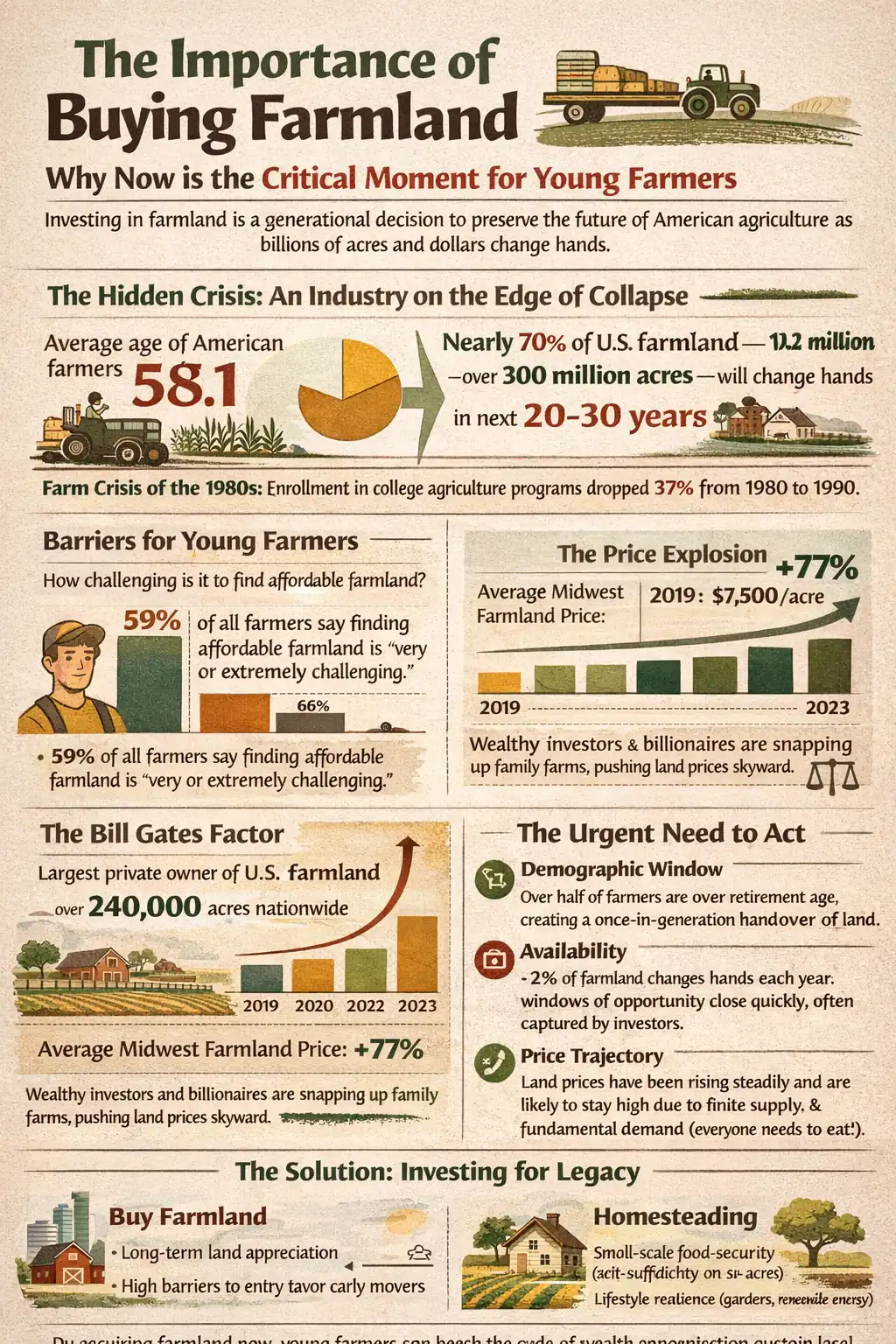
The average age of American farmers now stands at 58.1 years old, a metric that reveals a looming crisis. Less than 10% of farmers are under 35 years old, meaning that within the next 20-30 years, nearly 70% of U.S. farmland—over 300 million acres—will change hands. This astronomical transfer represents more than just a routine market shift; it’s a watershed moment that will determine whether American agriculture remains in the hands of family farmers or consolidates into the hands of corporate entities and wealthy investors.
This demographic shift wasn’t accidental. The farm crisis of the 1980s decimated generational agriculture, with families losing their land due to falling prices and overproduction. That economic devastation fundamentally altered how young people viewed farming as a career. From 1980 to 1990, enrollment in agriculture-related college programs dropped nearly 37%. That institutional knowledge gap, combined with generational wealth being concentrated in fewer hands, has created a perfect storm.
Today, finding affordable land is the number one barrier preventing young farmers from entering the industry. A staggering 59% of farmers report that acquiring affordable land is “very or extremely challenging,” and the situation is even worse for BIPOC farmers—68% of Indigenous respondents and 66% of Black respondents face extreme difficulty accessing land.
The Price Explosion: Farmland Worth More Than Your House
The economics tell the story of a market spiraling upward. In the Midwest—America’s agricultural heartland—farmland prices have skyrocketed from $7,500 per acre in 2019 to peaks of $13,000, with current sales hovering around $11,500 per acre. Regional variations are dramatic: Missouri commands $11,000-$16,000 per acre for quality land, while Florida premium properties fetch $60,000-$100,000 per acre. The average price trajectory is unmistakable and relentless.
Over the past six years, agricultural land prices have increased steadily, driven by fundamental demand—there will never be more land, but there will always be more people to feed. Yet this upward trajectory masks a darker reality: while family farmers struggle to afford this land, outside investors with deep pockets are buying it up.
The Bill Gates Factor: When Billionaires Own Your Neighborhood
Bill Gates has become the nation’s largest private farmland owner, accumulating over 240,000 acres nationwide, including approximately 20,000 acres across 19 counties in Nebraska alone. In just six years (2017-2023), Gates spent more than $113 million purchasing Nebraska farmland, more than double what the second-largest buyer spent in the same period.
What makes this concerning isn’t just the acreage—it’s the obscurity. Gates hides his ownership through more than 20 shell companies, many operating under innocuous names like “Mt. Edna Farms.” Ironically, many Nebraska residents who live next to Gates’s cornfields have no idea who owns the land. Even more troubling, Gates used his farmland as collateral for a $700 million loan in 2021, showcasing how farmland serves the ultra-wealthy not as a farming asset but as a financial tool for tax optimization.
Gates isn’t alone. Across Nebraska, vast acreage is held by the Church of Latter Day Saints, insurance companies, and investment funds—entities with no interest in farming, only in land appreciation and strategic positioning for future development. Meanwhile, young Nebraska farmers who grew up on agricultural land find themselves priced out of the market where their families have farmed for generations.
The Wealth Concentration Nightmare
Reddit users discussing the farmland crisis paint a bleak picture. One user noted that with over $84 trillion expected to transfer between generations in the next 20 years, we’re witnessing an unprecedented consolidation of land ownership. The concern is visceral: “They’re competing against wealth funds they can’t possibly hope to outbid for land. If they can afford the land they can’t afford the equipment and supplies to properly farm it. And if they can afford all that their reward is a pittance of a salary and most likely a lot of debt. The game is stacked against the average person.”
Large-scale operators and investment firms can pay more per acre than family farmers because they operate on economies of scale—they own thousands of acres and can absorb losses on individual parcels. Small farmers cannot compete with this calculus. Additionally, many investment funds aren’t even interested in farming; they’re land speculators waiting for parcels to convert from agricultural zoning to commercial or residential development, pocketing massive profits without ever planting a single crop.
The Profitability Paradox: Why Farmers Buy Land That Loses Money
The economics of the transaction described in the transcript reveal a paradox at the heart of American farming. The speaker purchased 80 acres for $850,000 ($10,625 per acre) but acknowledged that in the current crop environment, the land will not generate positive cash flow. Instead, corn sales will barely cover mortgage payments and property taxes, with operating costs (seed, fertilizer, irrigation, fuel) eating into any profit.
This isn’t incompetence—it’s the deliberate gamble that sustains farming. Corn prices fluctuated from $6.54 per bushel in 2022 to $3.90-$4.25 in 2024. At current prices of $4-$5 per bushel, the margin is razor-thin. Farmers are essentially betting that commodity prices will recover enough in future years to justify the purchase. They’re also banking on land appreciation—the real return on farmland typically comes not from annual crop sales but from long-term property value growth.
This math works only if you never sell the land and if you plan to pass it to the next generation. For family farmers, this is precisely the point. For investment firms, the calculus is different—they’re playing a different game entirely, one focused on financial optimization rather than agricultural production.
Why Now Is the Critical Moment
Several converging factors make farmland acquisition urgent for young farmers right now:
The Demographic Window: With over half of farmers over retirement age, the next 20 years represent the absolute peak moment when farmland is being transferred. In the aftermath of this transfer, the market will likely consolidate further, with surviving family farms becoming even larger and more entrenched.
Availability: Currently, about 1% of U.S. farmland changes hands through inheritance, gifting, or closed sales each year, while another 1% enters the open market. These windows of opportunity close quickly, often captured by the highest bidders with cash on hand—frequently investment firms.
Price Trajectory: Farmland prices show no signs of reversing. While some worry about a speculative bubble, history suggests farmland’s value is anchored by genuine demand (people must eat) and finite supply. This differs from purely speculative assets and suggests long-term resilience in property values.
Policy Support Erosion: Recent government policy changes, including the USAID shutdown that eliminated $2 billion in annual soybean purchases (representing 5% of U.S. soybean exports), are creating short-term pricing volatility and financial stress for farmers. However, long-term agricultural policy remains uncertain. Young farmers entering the market now may benefit from whatever policy adjustments emerge in response to current crises.
Community Continuity: Beyond economics, land ownership has profound implications for rural community vitality. When local farmers own local land, they make decisions rooted in community benefit and generational stewardship. When distant investment firms or billionaires own the land, farming operations are optimized for returns, not relationships. The quality of life in rural America deteriorates when farmers become renters on land they don’t own.
The Homesteading Movement: Reclaiming Self-Sufficiency
A parallel movement is emerging among younger people: intentional homesteading on smaller acreage. While not equivalent to commercial farming, homesteading offers compelling advantages. Research shows that families can achieve substantial self-sufficiency on as little as 5 acres, growing vegetables, fruit, and raising animals while generating surplus income through farmers markets or CSA programs. Property values increase substantially when land includes established gardens, orchards, or renewable energy systems.
For those priced out of commercial agriculture, homesteading provides a practical entry point into land ownership while offering genuine lifestyle benefits: reduced food costs, lower energy bills, connection to seasons, family engagement, and a sense of purpose. It also represents a hedge against economic uncertainty and supply chain disruption.
The Path Forward: Individual Action in Systemic Crisis
The decision to buy farmland—whether 80 acres for commercial agriculture or 5-10 acres for homesteading—carries both personal and societal implications. For individual farmers like those in the transcript, purchasing land near their home represented a choice to stay put, maintain community relationships, and secure their family’s future. It wasn’t a financially optimal decision in the short term, but it was a commitment to place and generational legacy.
For young farmers and rural enthusiasts facing the same decision, several truths emerge from current research and community discussion:
- The market is unlikely to become more affordable. Waiting typically means prices will rise and availability will shrink. Entry now, even with financing challenges, positions better than delaying.
- Financing matters more than down payments. Most commercial farmers cannot self-fund land purchases; 30-year mortgages financed at reasonable rates are industry standard. The real barrier for young farmers is access to financing institutions willing to take risks on new operators.
- Scale economies work both ways. Large operators benefit from land consolidation, but family farms that strategically add acreage can also improve their operational viability and reduce per-acre operating costs.
- Land ownership connects to food security. As commodity prices become more volatile and global supply chains face disruption, local food production matters increasingly. Families investing in farmland or homestead land are investing in genuine food security for their children.
- Policy intervention is essential. Individual purchase decisions alone cannot solve the structural crisis. Advocacy for policies supporting young farmer financing, land trusts, and regulations limiting speculative investment is necessary alongside personal action.
The Final Calculation
This captures the fundamental distinction between farmland as an investment asset and farmland as a home and heritage. For generational farmers, the purchase justifies itself not through immediate profitability but through the assurance of future autonomy, food production, family continuity, and community belonging.
As the largest intergenerational wealth transfer in American history unfolds over the next two decades, the urgency of farmland ownership for young farmers cannot be overstated. The question facing rural America isn’t whether farmland is a good investment—it’s whether that farmland will remain in the hands of the people who work it, or whether it will consolidate into a system where farming becomes impossible for ordinary people. The answer will largely be determined by decisions made in the next 5-10 years, as this generational transition unfolds.