
Understanding America’s Agricultural Landscape in 2026
The agricultural sector across the United States represents one of the most complex and economically significant industries in the country. While California often dominates headlines with its production value, the reality of modern farming reveals a far more nuanced story about scale, efficiency, and the diverse range of operations that feed the nation.
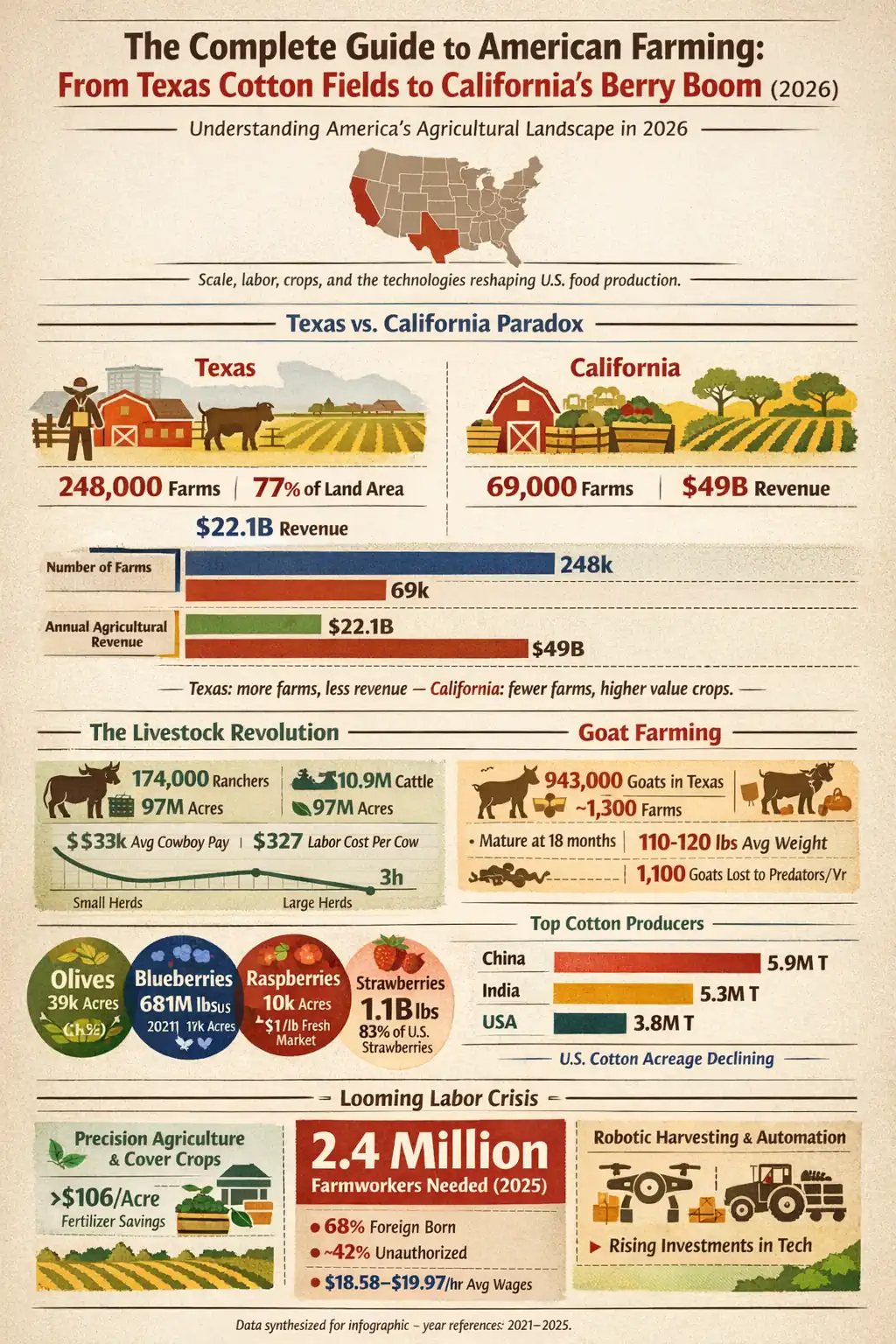
The Texas vs. California Agricultural Paradox
When examining U.S. agriculture, an interesting contradiction emerges: Texas operates more farms than California, yet generates less than half the agricultural revenue. Texas boasts approximately 248,000 operating farms that cover 77% of the state’s land area, generating about $22.1 billion in annual agricultural revenue. In stark contrast, California manages only about 69,000 farms but produces over $49 billion in agricultural revenue annually. This disparity reflects fundamental differences in crop selection, operational scale, and farming intensity between the two states.
This divergence isn’t coincidental—it reflects how modern American agriculture has evolved to favor high-value, labor-intensive crops in regions with ideal growing conditions. Texas emphasizes livestock and commodity crops, while California specializes in high-value produce that commands premium prices in national and international markets.
The Livestock Revolution: How Ranching Powers American Agriculture
Cattle Ranching: The Scale and Economics
Livestock dominates Texas’s agricultural economy, contributing approximately $12.3 billion to the state’s agricultural revenue—nearly 50% of the total. This dominance exists for good reason: cattle ranching represents a uniquely scalable operation that has been central to American agriculture for generations.
Modern Texas cattle ranches operate at an unprecedented scale, with the state hosting about 174,000 cattle ranchers managing approximately 10.9 million head of cattle—accounting for 13% of all cattle in the United States. These ranches span an extraordinary 97 million acres of grazing land, showcasing the enormous land requirements for beef production.
The labor dynamics of cattle ranching have shifted significantly. A typical working cowboy in Texas earns approximately $33,000 annually, a figure that reflects the challenging nature of the work. Unlike smaller livestock operations, large cattle herds require constant management. Cowboys and cattle dogs maintain control as herds travel up to 15 miles daily in search of quality forage. This mobile grazing system, while effective for animal welfare and land management, demands experienced handlers and creates the cultural identity of cattle ranching that remains iconic in American agriculture.
The economics become clearer when examining per-unit costs: labor expenses for cattle operations average approximately $327 per cow annually, with significant variation based on herd size and management practices. Larger operations benefit from economies of scale, reducing labor hours from 26 hours per cow on small herds (under 50 animals) to just 3 hours on large herds exceeding 500 animals.
Goat Farming: A Specialty Niche with Real Potential
While less visible than cattle ranching, goat farming represents a growing sector in American agriculture. Texas alone supports 943,000 goats distributed across more than 1,300 farms. These operations vary greatly in scale and purpose, with some raising goats for dairy production and others focusing on the meat market.
The economics of goat farming differ significantly from cattle ranching. A mature goat reaches full productivity at 18 months, weighing between 110 and 120 pounds. Daily feed requirements amount to approximately 4% of body weight, with 80% of that requirement met through grazing. This efficiency makes goats attractive for small-scale farmers and those with limited acreage.
Texas produces 53% of all goat meat consumed in the United States, with approximately 630,000 goats slaughtered annually in the state. However, predation presents a real challenge: an estimated 1,100 goats in Texas fall victim to coyotes and wildcats yearly. This reality has shaped modern goat farming practices, with farmers implementing protective measures to reduce losses. Afternoon herding into protected areas and predator management has become standard practice for serious goat operations.
Cotton: America’s Fiber Crop and Economic Indicator
Understanding Cotton’s Dominance in Texas
Cotton represents Texas’s most valuable agricultural crop, generating approximately $1.7 billion in annual revenue. The numbers tell an impressive story: Texas utilizes 5.3 million acres for cotton cultivation, representing 43% of the nation’s total cotton growing area. During the 2021 growing season, approximately 7,950 active cotton farms in the state harvested 7.7 million bales, with each bale weighing about 480 pounds.
The cotton harvest season extends from mid-October through December, a period when billions of cotton balls are mechanically packed into round bales by sophisticated harvesting equipment. Modern harvesting technology has transformed what was once intensely manual work into a capital-intensive operation requiring significant investment.
Global context matters for understanding cotton economics. While Texas produces enormous quantities of cotton, global production tells a different story about market dynamics. China leads worldwide cotton production with approximately 5.9 million tons annually, followed by India with 5.3 million tons. The United States, with 3.8 million tons, ranks third despite having more favorable growing conditions in many regions. This positioning reflects global trade dynamics, labor cost advantages in other countries, and the long-term shift toward higher-value crops in American agriculture.
Recent market trends show cotton acreage declining across the nation. The USDA estimates that national cotton planted area has decreased approximately 8% as of late 2025, with projections suggesting this trend will continue. Farmers are responding to market signals by diversifying into alternative crops or reducing planted area, creating uncertainty in cotton-dependent regions.
The Cotton Processing and Supply Chain
After harvest, billions of cotton bales are loaded onto trucks and transported to processing facilities throughout Texas and neighboring states. This logistics network has become increasingly sophisticated, with coordinated transportation and processing schedules maximizing efficiency and minimizing storage costs.
The Vegetable Revolution: California’s Fresh Produce Dominance
Asparagus and the Spring Harvest Rush
California’s vegetable industry relies heavily on seasonal labor coordination. Asparagus harvesting exemplifies this reliance: the end of May through early June brings thousands of migrant workers to asparagus farms in southern California. The annual asparagus market in the United States encompasses approximately 25,000 acres valued at $98 million, with California supplying a significant portion of this production.
Modern asparagus harvesting involves significant mechanization combined with hand-selection processes. After cutting, asparagus is placed in plastic trays and transported to packing facilities where sorting, grading, and packaging occur before shipment to wholesale produce markets and supermarket chains.
Cilantro: The Herb That Changed Agricultural Demographics
Cilantro production in Eastern Texas represents an interesting case study in American agricultural diversification. From April through September, hundreds of workers from Mexico harvest cilantro across 150 to 180 acres of Texas farmland. This production scale pales compared to California’s 4,000 acres of cilantro cultivation, yet it represents a growing commitment to specialty herbs in regional agriculture.
The cilantro harvest involves cutting and bundling operations performed by dozens of workers in coordinated teams. Unlike commodity crops harvested for wholesale, cilantro demands careful handling and rapid processing to maintain freshness. This labor-intensive approach requires investment in training, coordination, and quality control that differs substantially from commodity crop operations.
Lettuce Production and Per Capita Consumption Trends
Lettuce farming illustrates the scale of vegetable production in American agriculture. The United States dedicates approximately 119,000 acres to lettuce cultivation annually, with California producing 71% of the nation’s lettuce. Texas contributes roughly 3,700 acres to national lettuce production, positioning the state as a secondary but significant producer.
The average American consumes approximately 12.7 pounds of lettuce annually, a consumption pattern sustained only through continuous production across multiple growing regions and seasons. California’s Mediterranean climate enables year-round production, while other regions provide seasonal supply during complementary months.
Modern lettuce harvesting occurs in the field, with workers cutting heads and packing them directly into field-ready containers. This approach minimizes handling and maintains quality during transport to retail outlets. The entire process—from harvest to supermarket shelves—typically occurs within 48 to 72 hours, making coordination of multiple harvest crews and transportation networks essential for profitability.
The Berry Boom: High-Value Specialty Crops
California Olives: Manual Harvesting in the Modern Era
California’s olive industry represents approximately 39,000 acres across 682 farms, with unique production characteristics. Unlike European olive farming that relies heavily on mechanical harvesting, many California producers continue hand-harvesting due to specific market requirements for fresh olives. Approximately 220 farms still employ manual harvesting crews, typically workers from Mexico.
The economics of olive harvesting illustrate the high-value nature of specialty crops. Workers typically pick from 8 AM to 5 PM, with an experienced picker completing two mature olive trees daily. Compensation reaches approximately $95 per day—significantly higher than commodity crop wages and reflective of the skill and care required for fresh olive production.
California produced 116 million pounds of olives in 2024, processing them into oil and table olives that account for 75% of the nation’s olive production. This market dominance reflects both climatic advantages and established processing infrastructure.
Blueberries: The Labor-Intensive Specialty Crop
Blueberry production represents the apex of labor intensity in American agriculture. Washington State leads national blueberry production with approximately 17,000 acres generating consistently high yields and premium prices. The harvest season begins in early May, drawing approximately 7,000 workers annually to Washington’s blueberry farms.
The mechanics of blueberry harvesting remain largely unchanged from decades past: workers pick ripe berries by hand and place them in plastic containers worn across their chest. This manual process persists despite mechanization efforts because hand-picking preserves fruit quality and allows selective harvesting of ripe berries. A typical harvest worker picks 9 to 12 boxes daily, with compensation of approximately $9 per box—reflecting both the demand for quality work and competitive labor markets.
The blueberry labor challenge intensifies during peak harvest. A 100-acre blueberry farm requires approximately 1,000 workers during the eight-week harvest period to capture berries at optimal ripeness. This extraordinary labor demand creates challenges for growers, particularly as agricultural labor availability has become increasingly constrained across the nation.
The United States produced 681 million pounds of blueberries in 2021, with Washington alone accounting for 163 million pounds. This production supplies growing consumer demand for blueberries, which have seen remarkable growth in per capita consumption over recent decades.
Raspberries: Variability in Market Value
Raspberry production in California illustrates how market differentiation affects farm economics. The harvest season peaks in early July, drawing more than 2,000 workers to raspberry farms in Santa Cruz County. These workers pick ripe raspberries and place them in small buckets worn around their waists, receiving approximately $7 per bucket of berries.
California dedicates approximately 10,000 acres to fresh raspberry production, making the state the nation’s largest producer. This leadership reflects both ideal growing conditions and established supply chains for fresh fruit distribution. The economics of raspberry farming vary dramatically based on market destination: fresh market raspberries command premium prices exceeding $1 per pound, while processing raspberries receive significantly lower compensation.
Strawberries: California’s Signature Crop
Strawberry farming represents the crown jewel of California’s vegetable and berry agriculture. The state produces approximately 1.1 billion pounds annually—83% of the nation’s strawberry production—from approximately 35,000 acres. This production dominance reflects a perfect convergence of climate, soil, infrastructure, and market access that has made California the world’s premier strawberry production region.
The economics of strawberry farming have become increasingly challenging. Recent UC Davis research indicates that producing strawberries now costs approximately $113,000 per acre, representing an 18% increase since 2021. This cost escalation stems primarily from labor expenses, which have risen substantially as wage requirements have increased. In 2025, field workers in California strawberry operations earn a minimum of $19.97 per hour—higher than many urban service industry positions.
Despite these costs, the industry generates $5.4 billion in total economic impact for the United States, supporting over 50,000 jobs across production, packing, distribution, and related industries. For every dollar earned by strawberry farmers, approximately 95 cents flows into local communities through wages, services, and economic activity.
The profitability dynamics shifted in 2024 and 2025 due to expanded acreage reaching record levels. Increased supply contributed to lower market prices that failed to offset rising production costs, creating challenging profit margins. However, structural demand growth for strawberries remains strong, with per capita consumption growing faster than most other fruits.
Grape Leaves and Cherry Blossoms: Niche Markets with Premium Value
California’s agricultural diversity extends to unexpected crops. Grape leaves represent a traditional vegetable used in Mediterranean and Middle Eastern cuisines, with more than 6,000 pounds harvested annually. Approximately 150 migrant workers engage in this specialized harvest, earning approximately $9 per hour—lower than berry pickers but reflecting the smaller market and shorter harvest season.
Cherry blossoms emerged as a surprising specialty crop, with approximately 29,000 pounds harvested annually for food use. These delicate flowers, used in tea and cocktails by restaurants and beverage establishments, command premium compensation for pickers: approximately $80 to $100 per day—reflecting both the skill required and the premium market value.
Raisins: Converting Fresh Grapes to Dried Fruit
The Raisin Production Process
Raisin production represents a unique segment of American agriculture that transforms fresh grapes into a shelf-stable product. California’s Central Valley produces approximately 147,000 acres of raisins, accounting for 23% of the state’s total grape growing area. This production concentration makes California the world’s dominant raisin producer.
The raisin harvest occurs annually, drawing approximately 9,000 workers to California’s seedless grape vineyards. The work is notoriously difficult: harvesting occurs in intense heat, with dusty conditions common throughout the growing regions. Workers hand-pick seedless grapes destined for raisin production, a labor-intensive process that requires careful handling.
Following harvest, billions of grapes undergo a drying process lasting approximately three weeks on the farm. During this period, grapes are typically laid on paper between the rows, where sun exposure gradually removes moisture and converts the grape to a raisin. After drying, raisins are transported to processing plants for cleaning, sorting, and packaging before distribution to wholesalers and retailers.
The Labor Transformation: Understanding Agricultural Workforce Dynamics in 2025
The Growing Labor Shortage Crisis
American agriculture faces an unprecedented labor shortage that threatens production capacity across all sectors. The U.S. agricultural industry requires approximately 2.4 million farmworkers in 2025, yet faces consistent difficulty attracting and retaining adequate staffing. This shortage represents one of the most significant challenges facing American food production.
Multiple factors contribute to this labor crisis. The average age of American farmers continues rising, with many established farmers approaching retirement and fewer young people entering agriculture. Simultaneously, immigration policy uncertainties have created instability in labor availability, particularly for seasonal positions traditionally filled by migrant workers. In regions affected by immigration enforcement in 2025, agricultural operations reported 25% to 45% reductions in workforce availability—losses that directly translate to unharvested crops and economic losses.
Wage dynamics have responded to labor scarcity. Field workers now earn average hourly rates of $18.58 to $19.97, representing significant increases from prior years. Livestock workers command similar wages of approximately $18.15 per hour. These increases, while beneficial for workers, compress profit margins for farmers who must simultaneously manage rising input costs and often-stagnant commodity prices.
Migrant Labor and Regional Economic Impact
Approximately 68% of the American agricultural workforce consists of foreign-born workers, with roughly 42% of all farmworkers being unauthorized immigrants. This reliance on migrant labor has become structurally integral to American agriculture, particularly for labor-intensive harvesting operations. The seasonal nature of agriculture means migrant workers provide essential flexibility, arriving for harvest peaks and moving to other regions as seasons shift.
The economics of migrant labor reflect complex trade-offs. In regions where blueberries have become the dominant crop—such as parts of Peru—agricultural employment has expanded opportunities for previously marginalized worker populations. Women now comprise 60% of workers on Peruvian blueberry farms, compared to only 25% of agricultural workers nationally, demonstrating how crop selection can reshape employment demographics.
Modern Agricultural Trends and the Path Forward
Sustainable Farming Practices Gaining Adoption
The evolution toward sustainability in American agriculture reflects both environmental necessity and economic incentives. Precision agriculture tools, including GPS-guided equipment and soil sensors, enable farmers to apply water, fertilizer, and pesticides with unprecedented accuracy. These practices reduce input costs while minimizing environmental impact.
Cover cropping and crop rotation have demonstrated measurable economic returns. A seventh-generation Iowa farmer implementing cover crops achieved fertilizer cost savings exceeding $106 per acre, demonstrating that environmental stewardship and profitability align when implemented strategically. No-till farming practices protect soil structure, reduce fuel consumption, and improve long-term productivity.
The Technology and Automation Frontier
As labor shortages intensify, investment in agricultural technology has accelerated. Precision agriculture systems, robotic harvesting equipment, and automated sorting facilities represent the emerging frontier. Blueberry producers, facing extreme labor intensity, have partnered with inventors of blueberry-harvesting robots in response to labor availability crises. While mechanization cannot yet replicate hand-picking quality for all crops, technological advancement continues eroding the cost-quality trade-off.
Direct-to-Consumer and E-Commerce Models
Agricultural distribution is undergoing transformation through e-commerce platforms and direct-to-consumer models. Farmers increasingly utilize online marketplaces to bypass traditional supply chains, reducing intermediary costs and capturing premium direct-sale pricing. Subscription services and farm-to-table models appeal to consumers willing to pay premium prices for quality and traceability.
Conclusion: The Complexities of Feeding America
American agriculture encompasses extraordinary diversity—from sprawling Texas cattle ranches managing millions of animals across millions of acres to intensive California vegetable operations producing premium crops on relatively small land areas. Understanding this diversity requires moving beyond simple statistics about production volume or revenue figures.
The future of American agriculture depends on addressing interconnected challenges: labor scarcity combined with wage pressures, environmental sustainability balanced against profitability, and technological adoption in an industry with diverse farm sizes and capabilities. Success requires innovation across multiple dimensions simultaneously—efficiency improvements, new market access, and workforce solutions that recognize the dignity and essential contributions of agricultural workers.
For consumers, this complex agricultural system delivers extraordinary choice, quality, and abundance. For farmers, it presents both unprecedented challenges and opportunities to reshape how food reaches American tables. The coming years will determine whether American agriculture successfully navigates this transformation or faces significant disruption to the food system millions depend upon daily.